
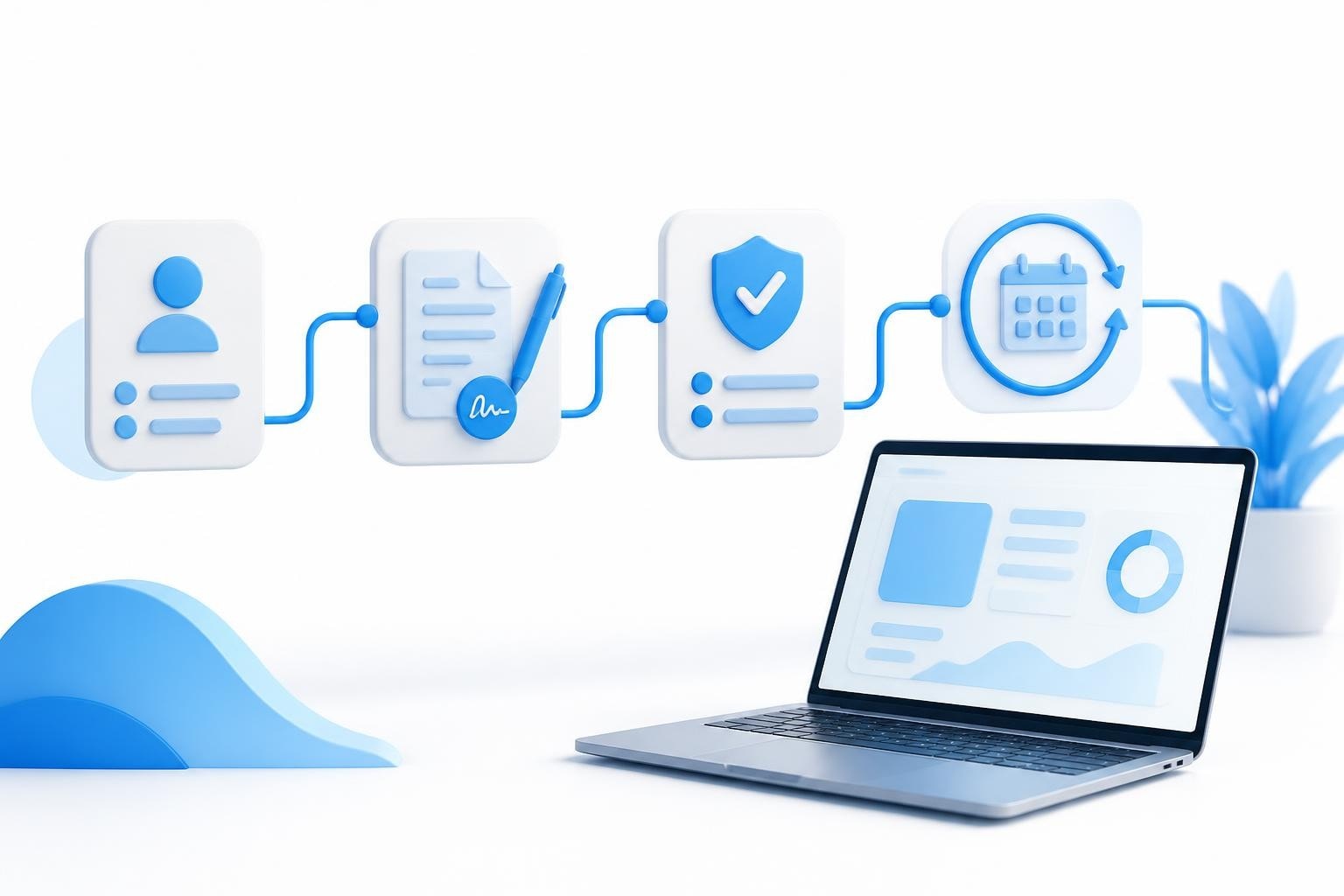
A reliable contracts system is the foundation of every successful creator agency. When you're managing 15, 30, or 50 models, verbal agreements and scattered PDFs create legal exposure, missed renewals, and revenue leakage. A structured approach to contract intake, signing, storage, and tracking protects both your agency and your talent while scaling operations efficiently.
Why Your Agency Needs a Dedicated Contracts System
Most agencies start with email attachments and Google Drive folders. That works until you hit double-digit rosters. Then you're hunting for signed agreements, missing compliance documents, and fielding questions about commission splits you thought were settled months ago.
A proper contracts system eliminates these friction points. It centralizes every agreement, tracks signature status in real time, and flags renewals before they lapse. This matters because creator agencies operate on recurring revenue models. A missed renewal means lost income, and chasing down a model for re-signature wastes hours your team could spend on talent development.
The Hidden Costs of Manual Contract Handling
Agencies without structured systems lose money in three ways. First, administrative overhead compounds as your roster grows. Second, compliance gaps create legal risk when models work across multiple platforms or jurisdictions. Third, missed renewals and poorly documented terms lead to commission disputes that damage relationships and reputation.

Consider the operational reality: every model requires an initial management agreement, platform-specific addendums, compliance documents, payment authorization forms, and potentially content usage rights. Multiply that by your roster size, then factor in amendments, renewals, and offboarding. Manual tracking becomes impossible beyond 20 models.
Building Your Contract Intake Process
The intake phase sets the tone for your entire relationship with a model. A smooth, professional process builds confidence. A chaotic one raises red flags before the partnership begins.
Start with standardized templates. Your base management agreement should cover commission structure, exclusivity terms, termination clauses, content ownership, and dispute resolution. Many agencies benefit from contract management best practices that emphasize standardization and digital accessibility.
Document Checklist for Model Onboarding
Every new model should complete this sequence:
- Management agreement (base contract)
- Identity verification documents
- Age verification records
- Banking and payment details
- Platform authorization forms
- Content rights agreement
- Non-disclosure agreement (if applicable)
This checklist ensures consistency across your roster. It also protects you during audits or disputes. When every model has identical documentation standards, you eliminate the "but my contract says" conversations that waste time and erode trust.
| Document Type | Purpose | Retention Period |
|---|---|---|
| Management Agreement | Defines commercial relationship | 7 years post-termination |
| Age Verification | Compliance requirement | Permanent |
| Payment Authorization | Enables commission processing | Duration of contract + 3 years |
| Platform Access | Grants agency management rights | Duration of contract |
Store originals in a centralized repository with version control. Never rely on models to maintain their own copies. You need immediate access during renewals, compliance audits, or termination proceedings.
Digital Signatures and Legal Validity
Paper contracts slow everything down. Models sign, scan, email, and you manually file. Digital signature tools eliminate this friction while maintaining legal enforceability.
Choose a signature platform that meets e-signature standards in your jurisdiction. Most agencies operate across state or international lines, so federal standards like the ESIGN Act (US) or eIDAS (EU) apply. The platform should capture signer identity, timestamp each action, and generate tamper-evident audit trails.
Your sign portal should guide models through the signature process step-by-step. Present documents in logical order, highlight signature fields, and require explicit consent to terms. This reduces confusion and ensures models understand what they're agreeing to.
Implementing Signature Workflows
A contracts system should automate signature collection. When a model moves from inquiry to onboarding, the system triggers a signature request containing all required documents. The model receives one link, signs everything in sequence, and the system notifies your team when complete.
- Pre-signature requirements: Age checks, identity verification, compliance screening
- Signature sequence: Management agreement first, then supporting documents
- Post-signature actions: Automatic filing, team notifications, onboarding workflow advancement
This automation matters at scale. When you're onboarding five models simultaneously, manual tracking becomes error-prone. Automated workflows ensure nothing falls through gaps.

Compliance Integration Within Your Contracts System
Creator agencies face unique compliance requirements. Age verification isn't optional. Platform terms of service impose specific obligations. Payment processing requires anti-money laundering documentation. Your contracts system must enforce these requirements, not just store documents.
Build compliance gates into your onboarding workflow. A model cannot advance to signature collection until age verification clears. Payment processing doesn't activate until banking documentation passes KYC checks. These gates protect your agency from regulatory exposure and platform bans.
Understanding compliance portal functionality helps you evaluate whether your current system meets industry standards. Look for features like automated expiration tracking, renewal notifications, and audit report generation.
Age Verification and Record-Keeping
Every creator must provide government-issued identification. Your system should capture the document, verify authenticity, extract birth date, and calculate current age. Store these records permanently and separately from standard contract files.
Many agencies overlook the ongoing nature of compliance. Documents expire. IDs get renewed. Platforms update verification requirements. Your contracts system needs automated monitoring that flags approaching expirations and triggers renewal workflows.
Managing Active Contracts and Amendments
Signing the initial agreement is just the beginning. Throughout the partnership, terms change. Commission structures adjust. Exclusivity evolves. Platform access expands or contracts. Each change requires documentation.
Treat amendments with the same rigor as original agreements. Use version control to track which terms apply on which dates. Store amendments alongside base contracts. Build a clear amendment process that requires mutual consent and signature.
When disputes arise, the first question is always "what does the contract say?" If you have multiple versions, conflicting amendments, or unclear effective dates, you've lost negotiating leverage. Clean documentation practices prevent these scenarios.
Contract Amendment Workflow
- Identify the specific terms requiring modification
- Draft amendment language referencing original contract sections
- Route for internal approval (legal, finance, operations)
- Send to model with explanation of changes
- Collect signature through your contracts system
- File amendment with cross-reference to base agreement
- Update internal systems (payroll, commission tracking) to reflect new terms
This formality protects both parties. It also creates a paper trail that proves terms were mutually agreed, not unilaterally imposed.
Renewal Tracking and Revenue Protection
Most management agreements run 12-24 months with auto-renewal clauses. Your contracts system must track these dates and trigger renewal workflows 60-90 days before expiration.
Missed renewals create operational chaos. Technically, you may lose management rights. Practically, you continue working under expired terms, creating legal ambiguity. Financially, you miss the opportunity to adjust commission rates or renegotiate exclusivity.
Implementing contract management best practices around renewal workflows protects revenue. Set up automated notifications to account managers, models, and finance teams. Build renewal packages that make re-signing frictionless.
| Renewal Timeline | Action Item | Responsible Party |
|---|---|---|
| 90 days prior | Performance review meeting scheduled | Account Manager |
| 75 days prior | Renewal package prepared with updated terms | Operations Team |
| 60 days prior | Renewal sent to model for review | Account Manager |
| 45 days prior | Follow-up if no response | Account Manager |
| 30 days prior | Executive escalation if unsigned | Agency Leadership |
| 15 days prior | Prepare offboarding if renewal unlikely | Operations Team |
This proactive approach prevents last-minute scrambles and gives you time to replace non-renewing models.
Integrating Your Contracts System With Operations
A contracts system shouldn't exist in isolation. It needs to connect with your leads pipeline, onboarding workflows, compliance tracking, invoicing, and payroll systems.
When a model signs their management agreement, that should automatically trigger several downstream actions. Their profile activates in your roster management system. Commission splits load into your invoicing logic. Compliance deadlines populate in your tracking calendar. Payment details flow to your payroll processing.
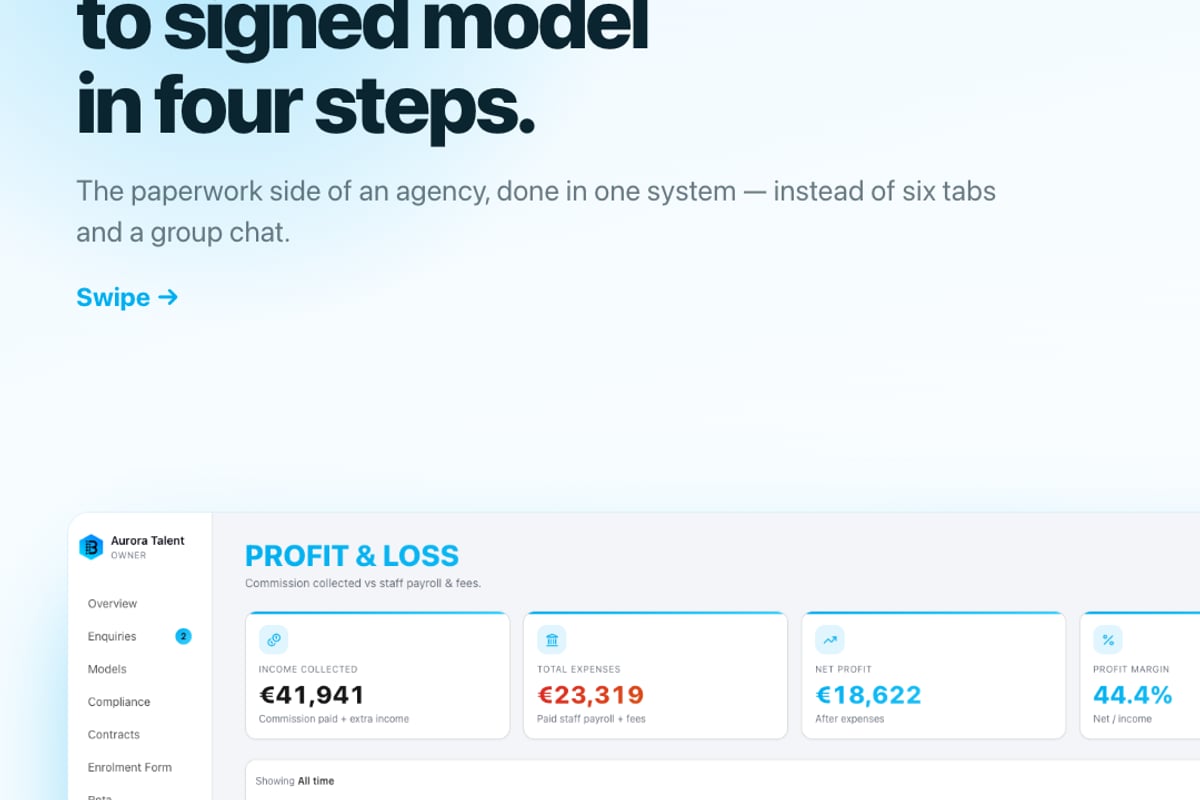
For agencies managing comprehensive operations, Creator Agency Operating System solutions provide integrated contract management alongside leads, compliance, invoicing, and live profit and loss tracking. This eliminates the data duplication and synchronization errors that plague agencies using disconnected tools.

Data Flow Architecture
Your contracts system should serve as the source of truth for key data points:
- Model identity information: Flows to compliance and payment systems
- Commission rates: Feeds invoicing and P&L calculations
- Contract dates: Drives renewal workflows and performance reviews
- Termination status: Triggers offboarding and final payment processing
When these data points update in your contracts system, they should propagate automatically. Manual data entry across multiple systems creates version conflicts and calculation errors.
Offboarding and Contract Termination
Relationships end. Models leave for competitors, retire, or breach terms. Your contracts system must handle termination gracefully while protecting your interests.
Document the termination reason and effective date immediately. Review the contract for notice requirements, final payment terms, and post-termination obligations. Many agreements include content usage rights that survive termination or non-compete clauses that remain enforceable.
Generate a termination agreement that formally ends the relationship and clarifies ongoing obligations. This document should address final payments, content ownership, confidentiality, and dispute resolution. Both parties sign, and it gets filed with the original management agreement.
Post-Termination Checklist
After a model departs, complete these steps within 30 days:
- Revoke platform access and admin rights
- Process final commission payments
- Archive all content and performance data
- Update roster counts and capacity planning
- Document lessons learned for retention improvement
- Ensure compliance records remain accessible per retention policies
Proper offboarding prevents former models from accessing confidential information, eliminates payroll errors, and closes compliance loops.
System Selection Criteria
If you're evaluating contracts system options, prioritize these capabilities:
Central repository with unlimited storage. You need space for hundreds of agreements plus supporting documents. Search functionality should let you find any contract in seconds using model name, date range, or contract type.
Automated workflows and notifications. Signature requests should route automatically. Renewal alerts should fire based on configurable timelines. Compliance deadlines should generate tasks for responsible team members.
Audit trails and version control. Every action should be logged with timestamp and user identity. Document versions should be tracked with clear indication of which version is currently effective.
Integration capabilities. The system should connect with your existing tools through APIs or native integrations. Standalone tools that require manual data transfer create more problems than they solve.
Many agencies implementing new systems benefit from guidance on developing and implementing contract management that emphasizes assessing current processes before selecting tools.
Scaling Your Contracts System Beyond 50 Models
At enterprise scale, your contracts system requires additional sophistication. You're managing hundreds of active agreements, dozens of renewals per month, and multiple team members handling contract administration.
Implement role-based access controls. Junior team members should access contracts relevant to their assigned models only. Finance needs read access for commission verification. Leadership requires full visibility for oversight and compliance.
Build reporting dashboards that surface key metrics. Track average time-to-signature, contract renewal rates, amendment frequency, and compliance document expiration dates. These metrics identify bottlenecks and process improvement opportunities.
Enterprise Contracts System Features
| Feature | Purpose | Impact |
|---|---|---|
| Bulk signature requests | Onboard multiple models simultaneously | 75% time reduction |
| Custom approval workflows | Route amendments through proper channels | Reduced legal risk |
| Advanced reporting | Monitor portfolio health and renewal pipeline | Proactive revenue management |
| API integrations | Sync with financial and operational systems | Eliminate manual data entry |
As your agency grows past 50 models, contract management shifts from administrative task to strategic function. The quality of your documentation directly impacts valuation if you pursue acquisition or investment.
Frequently Asked Questions
How long should creator agency contracts run? Most agencies use 12-month initial terms with 6-month or 12-month auto-renewal periods. Shorter terms provide flexibility to adjust rates. Longer terms provide revenue stability. Balance based on your market position and model quality.
What happens if a model refuses to sign an amendment? The original contract remains in effect. If the amendment addresses a business-critical change (like new platform requirements), you may need to invoke termination clauses. Always document why the amendment is necessary before sending.
Can we enforce non-compete clauses with creators? Enforceability varies by jurisdiction and how narrowly the clause is written. Courts generally disfavor broad restrictions on earning capacity. If non-competes are important to your model, consult legal counsel to draft enforceable language.
Contract Templates and Standardization
Every agency needs a template library covering common scenarios. Your base management agreement should exist in multiple versions: exclusive representation, non-exclusive, tiered commission structures, and performance-based adjustments.
Standardization accelerates onboarding and reduces legal review costs. When 80% of your contracts use standard language, you only pay attorneys to review the custom 20%. Templates also ensure compliance requirements appear consistently across all agreements.
Maintain a master template repository with clear version numbers and effective dates. When legal counsel recommends updates, implement them in the templates and flag older agreements for amendment.
Understanding how agencies structure OnlyFans management contracts helps you benchmark your templates against industry standards while ensuring your specific needs are met.
Security and Confidentiality in Your Contracts System
Creator agency contracts contain sensitive information: personal identity details, banking information, earning data, and confidential business terms. Your contracts system must protect this data with enterprise-grade security.
Implement encryption for data at rest and in transit. Use multi-factor authentication for all user accounts. Limit download and print permissions to prevent unauthorized distribution. Maintain detailed access logs that track who viewed which contracts when.
Regular security audits should verify that permissions match current team structure, terminated employees have been removed, and no unauthorized access has occurred. These audits also satisfy due diligence requirements if you pursue investment or acquisition.
Measuring Contracts System Performance
Your contracts system should improve efficiency over time. Track these metrics monthly to identify improvement opportunities:
- Average time from inquiry to signed contract
- Percentage of contracts signed within 48 hours
- Contract renewal rate (target: above 80%)
- Amendment frequency per model per year
- Compliance document expiration incidents
- Audit finding resolution time
When metrics trend negatively, investigate root causes. Are templates confusing? Is the signature process too complex? Do account managers need better training on renewal conversations? Data-driven improvements compound over time.
Building a robust contracts system transforms creator agency operations from reactive firefighting to proactive management. When every agreement is centralized, standardized, and tracked systematically, you eliminate compliance gaps, protect revenue, and scale confidently. BIGROS provides the integrated platform creator agencies need, combining contract management with leads, onboarding, compliance, invoicing, and real-time financial insights-all designed specifically for the unique requirements of managing creator talent at scale.