
Running a creator agency means juggling dozens of payment cycles simultaneously. Between model payouts, client billing, and platform fees, the invoicing workload grows exponentially as your roster expands. Auto invoices solve this problem by eliminating manual data entry and ensuring every payment is documented, compliant, and trackable. For agencies managing 15-20 models or more, automated billing isn't a luxury; it's the foundation of sustainable operations.
Why Manual Invoicing Breaks Down at Scale
When you're managing five or six creators, manual invoices are manageable. You can track payments in spreadsheets, remember who gets paid when, and handle the occasional late payment without much friction. But as you scale past fifteen models, the system collapses.
The math is simple: if each model generates two invoices per month (one for platform earnings, one for agency commission), twenty models create forty invoices monthly. Add client billing for management services, contractor payments for chatters and content editors, and platform fees, and you're suddenly processing 60-80 invoices every thirty days.
Manual entry at this volume introduces three critical risks:
- Payment errors that damage trust with talent
- Compliance gaps that expose your agency to legal issues
- Cash flow blindness when you can't see what's outstanding
The transition to auto invoices typically happens when agencies experience their first major billing mistake or when founders realize they're spending 10-15 hours per week just on invoice creation. Professional invoicing practices become non-negotiable as your operation matures.

Essential Components of Creator Agency Auto Invoices
Not all automated invoicing systems are built for the creator economy. Traditional invoicing tools designed for product sales or hourly services miss critical elements that OFM agencies need daily.
Model-Specific Line Items
Your auto invoices must accommodate the unique revenue splits in creator management. A single payout might include:
- Platform earnings (gross revenue)
- Agency commission percentage
- Deductions for purchased services (photoshoots, equipment)
- Bonuses for hitting performance milestones
- Tax withholding where applicable
Each line item needs to reference the correct time period, because platform payouts often lag by 7-14 days. An invoice dated March 15th might be settling February 1-28 earnings. Clear date ranges prevent confusion and reduce payment disputes.
Compliance Documentation
Every invoice in the creator space doubles as a compliance record. Auto invoices should automatically attach or reference:
- The active management contract
- Age verification documentation
- Tax forms (W-9, 1099 preparation data)
- Payment method authorization
When structured correctly, your invoice management system becomes your first line of defense in an audit or legal inquiry.
Multi-Party Visibility
Creator agencies operate with at least three stakeholders per invoice: the agency, the model, and often the model's accountant or business manager. Auto invoices need to:
- Generate automatically on payout schedules
- Deliver to multiple recipients simultaneously
- Provide read receipts and download tracking
- Support secure portal access for historical records
Many agencies that have scaled successfully use a centralized agency system that provides role-based access to financial documents, ensuring models see their own data while staff maintain oversight across the entire roster.
Setting Up Effective Auto Invoice Workflows
Implementation determines whether automated invoicing actually saves time or just digitizes existing chaos. The setup phase requires thoughtful planning around your specific agency operations.
Define Your Billing Cadence
Creator agencies typically choose between three invoicing schedules:
| Schedule | Best For | Considerations |
|---|---|---|
| Platform-synced | Agencies with 5-15 models | Matches platform payout dates; simplest to explain |
| Bi-monthly fixed | Agencies with 15+ models | Predictable cash flow; easier payroll planning |
| Milestone-based | Performance-focused agencies | Ties payouts to goals; requires clear tracking |
The best practices for recurring invoices suggest aligning your cadence with your cash flow needs first, then communicating that schedule clearly during model onboarding.
Most agencies find bi-monthly fixed schedules work best after crossing twenty models, because platform-synced payments create unpredictable administrative burdens when you're managing multiple payout calendars.
Automate Data Integration
Manual data transfer defeats the purpose of auto invoices. Your system should pull earnings data directly from:
- Platform analytics APIs
- Time tracking for hourly contractors
- Content delivery metrics if you bill per post
- Expense reimbursement submissions
The integration layer is where most DIY solutions break down. A spreadsheet can generate an invoice template, but it can't automatically populate accurate figures from five different data sources. Purpose-built creator agency software handles these integrations natively.
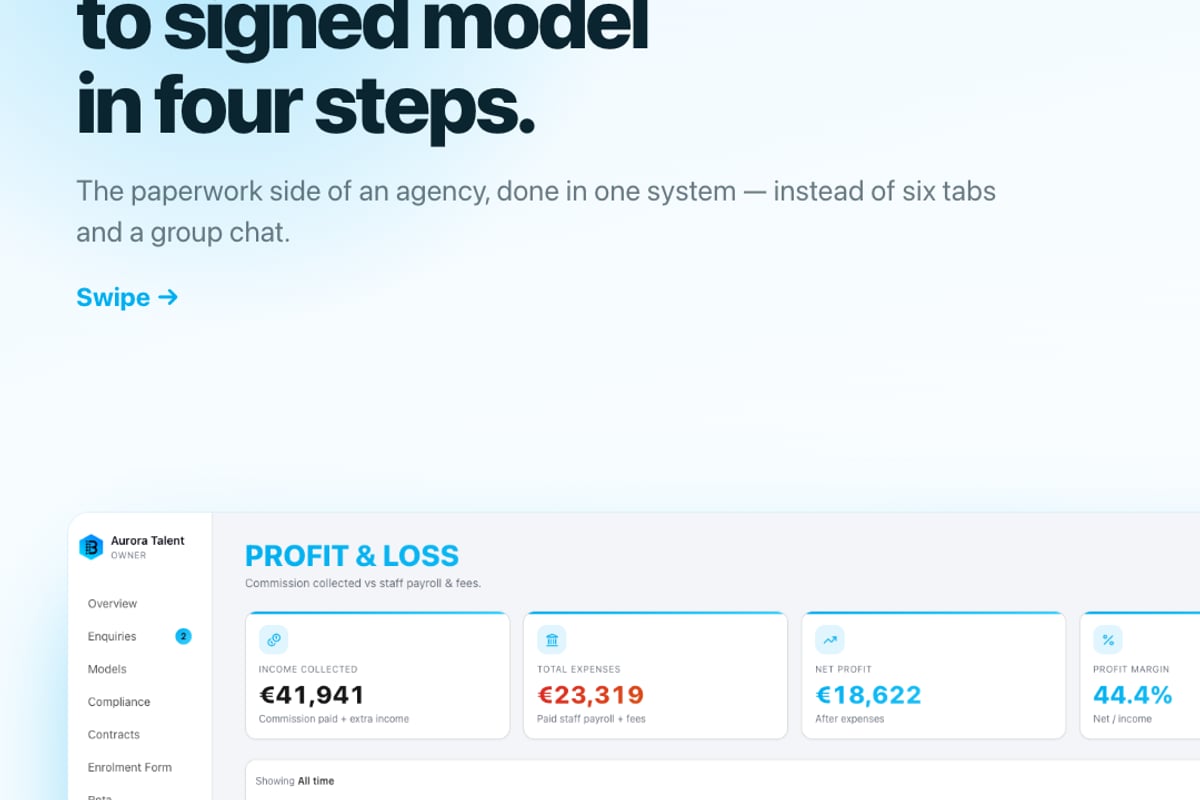
BIGROS consolidates all payment data into a single operating system, automatically generating invoices from platform earnings, contract terms, and approved expenses. This eliminates the error-prone copying and pasting that plagues manual workflows, while maintaining live profit and loss visibility across your entire roster.
Implement Approval Workflows
Even automated systems need human oversight. Build approval steps before invoices finalize:
- Model review period: 48-72 hours for creators to flag discrepancies
- Finance approval: Manager sign-off for amounts exceeding thresholds
- Batch review: Weekly or bi-weekly check of all pending invoices
These gates catch errors before money moves, which is exponentially easier than reversing payments. Your invoice checks should verify contract percentages, confirm all deductions have supporting documentation, and flag any unusual payment amounts.

Compliance and Tax Considerations
Auto invoices are financial records that must withstand scrutiny from tax authorities, legal teams, and platform compliance departments. Setting up your system correctly from the start prevents expensive remediation later.
Invoice Numbering Standards
Your numbering system needs to be sequential, unique, and trackable. Invoice number format best practices recommend structures that embed useful information:
- Format: AGENCY-YEAR-SEQUENTIAL (e.g., BIGR-2026-0847)
- Never skip numbers or reuse IDs, even for voided invoices
- Separate sequences for different invoice types (model payouts vs. client billing)
This becomes critical when you need to locate a specific transaction six months later or demonstrate an unbroken audit trail.
Data Retention and Access
Your auto invoice system must:
- Store invoices in uneditable formats (PDF/A is standard)
- Maintain backups in geographically separate locations
- Provide instant retrieval for any historical invoice
- Support bulk export for tax preparation or legal discovery
Many agencies overlook the importance of proper compliance portal infrastructure until they face their first legal hold or multi-state tax audit. The cost of retroactively organizing five years of invoicing data far exceeds the investment in proper systems upfront.
Multi-Jurisdiction Tax Handling
As your roster grows, you'll inevitably work with models across state lines or international borders. Auto invoices need to:
- Apply correct tax rates based on model location
- Track 1099 thresholds and generate forms automatically
- Flag international payments requiring additional documentation
- Calculate and display tax withholding clearly
The complexity here is exactly why automated billing best practices emphasize configuration over customization. Set your rules once, then let the system apply them consistently.
Accelerating Payment Collection
Generating auto invoices quickly means nothing if you're still chasing payments thirty days later. Payment velocity directly impacts your cash flow and ability to scale.
Payment Method Integration
Auto invoices should offer multiple payment options, ranked by speed and cost:
- ACH/bank transfer: Lowest fees, 2-3 day settlement
- Payment platforms (Venmo, PayPal, Zelle): Instant, higher fees
- Wire transfer: Same-day, highest fees, used for large amounts
- Crypto: Emerging option, variable settlement times
Configure default methods by model based on their preferences established during onboarding. The fewer clicks between invoice receipt and payment initiation, the faster you collect.
Automated Reminders and Escalation
Payment delays are often logistical, not intentional. Effective reminder sequences:
- Day 0: Invoice delivery with payment link
- Day 3: Friendly reminder if unpaid
- Day 7: Second notice with payment instructions
- Day 14: Escalation to agency manager
- Day 21: Formal late payment notice
These communications should be automatic but personalized. Generic "Your payment is overdue" emails get ignored; "Your February 1-15 earnings payment of $X.XX is ready" gets action. Invoice formatting and delivery best practices emphasize clarity over formality in B2B contexts.
Late Payment Automation
Your auto invoice system should trigger consequences for persistent delays:
- Pause content plan assignments for unpaid models
- Flag accounts for manager review after two late payments
- Automatically calculate and add late fees per contract terms
- Generate payable invoices reports for weekly finance reviews
The goal isn't punitive action; it's systematic enforcement of payment terms that protects your agency's cash flow.
Integration With Broader Agency Operations
Auto invoices don't exist in isolation. They're one component of your complete financial and operational infrastructure.
Connecting to Payroll Systems
When you're paying chatters, editors, and other contractors, your invoice system should feed directly into payroll:
- Generate contractor invoices automatically from logged hours
- Cross-reference against project budgets and model allocations
- Calculate net payouts after agency commission and expenses
- Sync payment dates with your own bank account funding
This bidirectional flow means how you pay OnlyFans creators directly influences how you pay your team. Delays in platform payouts cascade through your entire operation unless you have buffer capital.
Real-Time Profit and Loss Visibility
Auto invoices generate the data for live P&L dashboards. When every transaction is automatically recorded and categorized, you gain:
- Model-level profitability: Which creators generate margin after all costs
- Service-line analysis: Whether content creation, chatting, or other services are profitable
- Cash flow forecasting: Projected receivables and payables for the next 30-60 days
- Budget variance tracking: Actual spend versus planned expenses by category
This financial visibility transforms how you make decisions about recruiting new models, commission rate structures, and service expansion.
Audit Trail for Due Diligence
Whether you're seeking investment, preparing for acquisition, or defending against legal claims, your auto invoice history is critical documentation. A properly configured system provides:
| Documentation Type | Use Case | System Requirement |
|---|---|---|
| Complete transaction log | Financial audit | Immutable records with timestamps |
| Compliance documentation | Platform investigations | Linked age verification, contracts |
| Payment proof | Dispute resolution | Delivery confirmations, receipts |
| Tax records | IRS audit or state review | Categorized expenses, 1099 data |
Agencies that maintain clean invoice records from day one have exponentially easier due diligence processes when growth opportunities emerge.

Common Auto Invoice Implementation Mistakes
Even agencies committed to automation make predictable errors during setup and operation. Learning from these patterns saves significant time and money.
Over-Customization at Launch
The temptation is to build the perfect system that handles every edge case on day one. This leads to:
- Delayed implementation while debating minor features
- Complex workflows that confuse team members
- Brittle systems that break with small data changes
Start with the core functionality: auto-generate model payout invoices from platform data, send them on schedule, track payment status. Add sophistication after you've proven the basics work reliably.
Ignoring Model Communication
Auto invoices can feel impersonal, especially to creators who are new to professional business operations. Common complaints include:
- "I don't understand these line items"
- "Why is my payment different this month?"
- "How do I access my invoice history?"
Solve this with onboarding education and accessible documentation. Your contracts system should explain invoice timing and structure before the first payment. Regular FAQ updates based on actual questions prevent repetitive support requests.
Failing to Test Payment Failure Scenarios
Auto invoices work perfectly until they don't. What happens when:
- A model's bank account is closed
- Payment platform limits are exceeded
- Invoices contain data errors that block processing
- Systems are down during scheduled invoice generation
Build and test failure protocols before you experience them in production. Manual override capabilities, error logging, and clear escalation paths turn potential disasters into minor inconveniences.
Frequently Asked Questions
How do auto invoices handle split payments when models work with multiple agencies?
Auto invoices should reference specific time periods and revenue sources clearly. If a model splits time between agencies, each organization invoices for its managed revenue only. The invoice line items must specify "Platform earnings February 1-15 for content managed by [Agency Name]" to avoid confusion. Coordination happens at the contract level, not the invoice level.
What's the minimum roster size where auto invoices become cost-effective?
Most agencies see ROI around 10-12 active models, when manual invoicing requires 8-10 hours monthly. The calculation is straightforward: if automation costs $200/month and saves 10 hours of $30/hour labor, you break even at 6.7 hours saved. The real value comes from error reduction and faster payments, not just time savings.
Can auto invoice systems generate invoices in different currencies for international models?
Yes, but you need to configure base currency, conversion rate sources, and timing. Most systems either invoice in your base currency (model handles conversion) or lock exchange rates at the invoice generation date. Be explicit in contracts about currency, who bears conversion fees, and how rate fluctuations are handled.
Scaling Your Auto Invoice Infrastructure
As your agency grows from twenty models to fifty or beyond, your invoicing needs evolve. The system that works at launch will need enhancements.
Multi-Entity Structures
Larger agencies often operate through multiple legal entities for tax optimization or jurisdiction requirements. Your auto invoice system must:
- Track which entity each model contracts with
- Generate invoices with correct entity details and tax IDs
- Maintain separate numbering sequences per entity
- Consolidate reporting across entities for management view
This complexity is exactly why purpose-built creator agency management software outperforms general accounting tools at scale.
Team Permissions and Workflows
With multiple staff members handling finance, you need granular permissions:
- Invoice creators (can generate but not approve)
- Approvers (can review and authorize payments)
- Viewers (read-only access for reporting)
- Administrators (full system configuration)
Role-based access prevents errors and creates accountability. When every invoice action is logged with user attribution, you can trace any issue to its source.
Advanced Analytics and Reporting
Your invoice data becomes a strategic asset for understanding how much OnlyFans agencies make and where profitability comes from. Advanced reporting includes:
- Average days to payment by model or payment method
- Invoice dispute rates and resolution times
- Revenue per model versus operational costs per model
- Seasonal patterns in platform earnings and payment timing
These insights inform staffing decisions, service pricing, and growth strategy.
Auto invoices transform creator agency operations from reactive payment processing to proactive financial management. When every transaction is documented, compliance is automated, and cash flow is visible in real-time, you gain the operational foundation necessary to scale confidently past twenty models and beyond. BIGROS provides the complete invoicing infrastructure creator agencies need, integrating automated billing with compliance tracking, contract management, and live P&L dashboards on a single platform. See how BIGROS eliminates manual invoicing and gives you back time to focus on growing your roster.